

Spanish Muslims, German Barbarians, and English Priests
When the Islamic Umayyad Caliphate conquered what is now Spain, they brought a variety of cultural artifacts with them into the newly-acquired territory. What was once Celtic-dominated Iberia and later the Roman provinces of Hispania was now Al-Andalus. For an example of Arabic (you’ll often hear it called “Moorish” in the context of Spain) influence on Spanish culture, just listen to some flamenco guitar music. The unmistakably serpentine curvature of the harmonic minor scale from plucked strings, dancing around rapidly strummed major chords a half-step apart from each other bears an obvious influence from Arabic and other Middle Eastern musical traditions. Such artful delights of Moorish provenance are not merely confined to the auricular sphere however. Look around Spain, and you will notice one particular architectural feature in many old buildings. In the entrance to great cathedrals, city halls, and other gathering spaces, a great wooden door or empty arcade gradually curves up into a sharp point. Profoundly medieval and foreboding, that same pointed arch carries with it the universal language of the ancient, the medieval, the spooky and stately. The pointed arch was imported into Al-Andalus by the ruling Muslims, who used it in their own architectural projects and then saw it spread among the populace. This arch and numerous other architectural features coalesce into a style whose name is equally as evocative as it is imposing. What do you imagine, cherished reader, when I tell you that something, a building, a song, a fashion, a novel, a film, is Gothic?
Well, in order to figure out where the appellation comes from, let’s return to the pointed arch. The pointed arch was a staple of architecture across the Islamic world from around the 7th century onward (Herzfeld, 2016), although its precise origins are much older. From Egypt to Iraq to Uzbekistan, Mosques and other religious structures in the domain of Islam have borne pointed arches in their doorways and arcades much longer than European buildings have. Spain was the first place on the continent to use this feature, and the arch gradually spread to other European territories. When the pointed arch reached France, it was combined with two construction techniques common to the Romanesque architecture, which was the previously dominant style in Europe (Bogdanović, 2010). Romanesque architecture heavily featured rounded rather than pointed arches, but the two techniques borrowed into the new style were flying buttresses and rib vaults. I remember hearing the term “flying buttress” as a kid, and laughing. I think that I heard it while watching the movie Harriet the Spy at summer day-camp. For a long time, I thought that a flying buttress was a large tower, but it’s actually a kind of arched ramp attached to an exterior wall of a building that helps prevent the walls from collapsing outward. Rib vaults are vaults or streaks in a stone ceiling that help to create a lighter and stronger roof. When the French combined rib vaults, pointed arches, and flying buttresses into the magnificent Basilica of Saint-Denis in the 12th century, a new style was born (Wakin, 1986). But what were the reactions from the public?
At first the general public was highly in favor. The new construction techniques and features of this style allowed for more light to easily enter the cathedrals and parish churches that had been built in this fashion. This new style was termed the opus Francigenum or opus modernum, which are Latin for “French work” and “modern work” respectively. You can already see a problem with that name though; none of the three main architectural features of this new style were French. Christopher Wren, the noted Baroque and Classical architect of 17th century London, noted as much when he wrote that pointed arches were not French in origin, but rather came from the architecture of the “Saracens”, another outdated term for Muslims (Bolton, 1925). And like I said earlier, buttresses and rib vaults were already in use in Romanesque styles, which originated in northern Italy. Still, France is where the style was popularized, so I can’t really blame people for calling the style that was coming from France “the French thing”. This French thing diffused further, with the style taking hold in the Holy Roman Empire, Italy, and across the Channel in England. Although popular at first, tastes don’t last forever, be that in fashion, architecture, music, or any other medium. What’s popular today will be passé, dated, or even, God forbid, cringe in a few years. The French thing was no different. With the arrival of the Renaissance in Europe, which was itself partially spurred on by rediscovery of old texts that had been well-preserved by Muslim scholars, Classical architecture was the talk of the town again. Imitation of Roman and Greek styles became the thing to do among the most popular architects. The ancient masters were to be imitated, and the newer styles scorned and degraded as vulgar, gloomy, and a remnant of a sad bygone era. And how would they describe the French style, something as ugly and pretentious as a mixture of features originating from heretical invaders and backwards, dark-age simpletons? Renaissance scholar Giorgio Vasari inaccurately attributed this style to the Goths (Vasari, 1907), a Germanic people group who raided, warred with, and eventually overthrew the Western Roman Empire in the late 5th century. And thus, the French thing was no longer the French thing, but rather Gothic architecture. Make no mistake, this was an insult. To use a modern analogy, associating this style with the Goths would be like calling a new architectural style “Chud-esque” in the modern day. Vasari thought of the worst group of barbarians and scoundrels he could, linked them with an unrelated trend he didn’t like, and called it a day.
Ok, so when we call other things Gothic today, it’s because they’re gloomy right? Yes, in terms of novels at least. When moody, atmospheric fiction with macabre elements started to be published, critics called this degenerate and debased art form Gothic, just like Renaissance artists had called degenerate and debased architecture Gothic. There’s one step missing from this story still. Lots of people like Gothic things, and it’s used as a neutral descriptor of a style instead of a blanket insult. In order to find out how it got its modern connotation, we have to go to the one place in Europe where Gothic architecture survived as the predominant style longer than anywhere else. This is a place where the Renaissance didn’t immediately displace Gothic with Classical style, but instead saw it survive into the era of Baroque. A place where a fundamental part of the national character was at one time bound up with the supposed superiority of Gothic architecture. A place where the whole country is dotted with pristine examples of Gothic churches, both from its original time period and the later revival. And that place, which we will head to for the rest of this journey, is England. Unlike the rest of Western Europe, Gothic endured as a popular style in England throughout the Renaissance, into the Early Modern Period or around 1680. Perhaps it was the desire to be decidedly and markedly different from the continent. England has always had a sense of pride in being unique, whether in architecture, global power, cultural attitudes, or religious doctrines. For many, the Gothic style was and is fundamentally English. To a varying extent, a sense of pride in each of these four areas would later lead to the Gothic Revival style in the 19th and 20th centuries. In any case, Gothic did survive longer in England than in other places in Europe.
Eventually, Gothic did fall out of fashion in England as well. Classical and Baroque came to be the most popular style of ecclesiastical architecture, exemplified by the exquisite constructions of the aforementioned Christopher Wren’s churches in London. Although many praised St. Paul’s Cathedral, which Wren designed in the Baroque style, some criticized it as “unfamiliar… and un-English” (Tinniswood, 2001). Baroque, with its flourishing curlicues and imperial pomp was associated with the absolutist monarchies of Europe, and even worse, with Catholicism. Since the English reformation had replaced the Roman hierarchy with English bishops and an English national church, Catholicism was considered a noxious, devious, superstitious foreign religion. How ironic that Gothic architecture was now being celebrated, when it was at first vilified in the same way as Baroque was. Tastes changed again, as they were wont to do, and by the mid-1700’s Gothic was a thing of the past. But then, something peculiar happened. A romantic and nationalist movement swept through England, emphasizing the shared cultural identity of England throughout the entire history of the land. From the Anglo-Saxons, to the Viking invasions, to the Norman age, to the days overseas colonies, Britain’s history was glorious, and to be celebrated. And what would be a better way to celebrate English history and Englishness than by reviving the architecture that had characterized the proudest constructions of the Middle Ages? At the same time, the Oxford Movement was sweeping through the Church of England. This was a high-church movement, meaning that they placed a high emphasis on liturgy and ritual, architecture, private devotion, and the unbroken heritage of the English church from the time of the Saxons to the present (Booty, Sykes, & Knight, 1998). This movement eventually became called Anglo-Catholicism, and the Anglo-Catholics were also in favor of medieval things, whether that be pre-Reformation worship and liturgy, philosophy and theology that reflected undivided and universal (Catholicos in Greek) or Gothic styles. They also desired a recovery of that which had been lost in the iconoclasm and rapid change of the English Reformation, such as the suppression of the Sarum Rite (the older English form of communion service), destruction of statues and rood screens, and the disbandment of monasteries and monastic life under the orders of Henry VIII and his crew of reform-minded bishops and advisors.
In the UK, the Gothic Revival had begun. New churches, train stations, and public buildings were constructed in a self-conscious imitation of earlier English Gothic. And it wasn’t seen as barbaric anymore. Gothic was no longer a pejorative term, but a fully-fledged respectable art form. Gothic-style furniture and fashion, which also imitated medieval styles, was now extremely popular. This wasn’t just a couple of devoted Renaissance Fair nerds, but the entire country was swept up in the Gothic Revival. Even the colonies made grand works in the Gothic Revival style. In Montreal, the Notre-Dame-de-Montreal Catholic Basilica was completed in 1829. I’ve visited it numerous times, and every time I’m absolutely blown away by the sheer grandeur, beauty, and otherworldly force of the interior and exterior. The picture below is from my visit to Montréal with my dad in spring 2022.
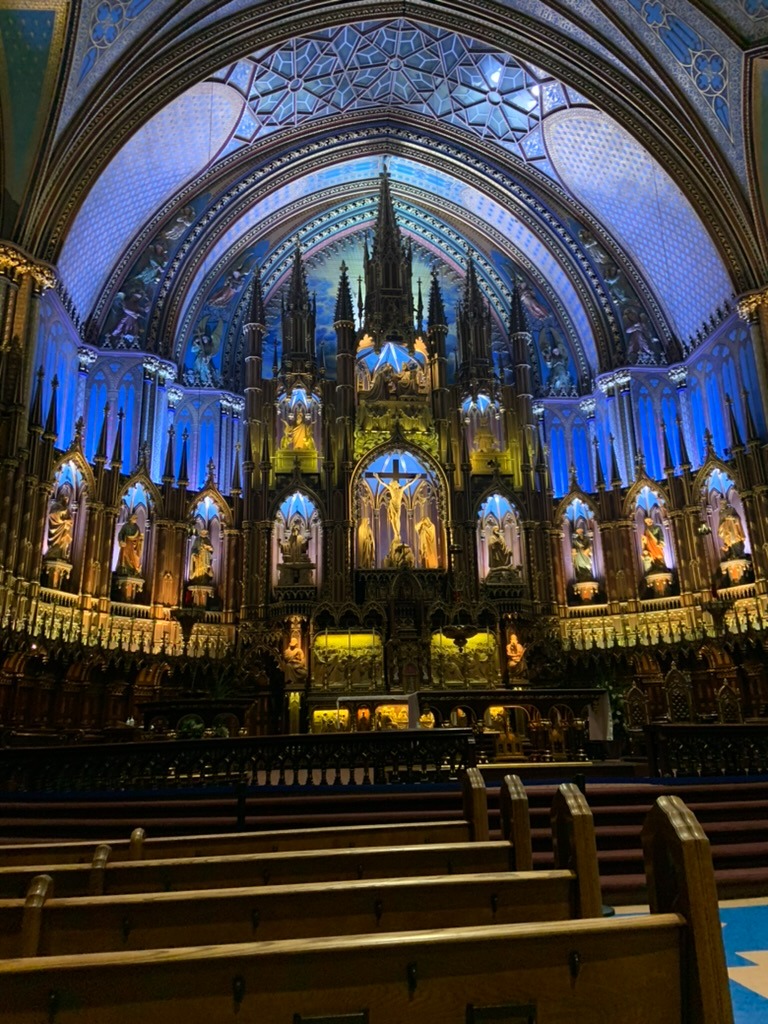
The high altar at Notre-Dame-de-Montreal Basilica
in Montreal, Quebec. Taken by me in 2022.
A style that was previously denigrated as vile and lacking in taste was now being argued as a force for moral good in the world, even. Critic A.W.N. Pugin argued that the Gothic style, and the whole medieval mindset, reflected a society that was true and good, while fellow critic John Ruskin admired the handmade stone craftsmanship of Gothic buildings as reflecting a spiritually and morally enriching practice, in contrast to the soulless and soul-crushing industrial manufacturing that had propelled England to global superpower status (The Gothic Revival, 2002). Even if the Industrial Revolution had brought new wealth to England, what was the cost? Giant machinery billowing toxic fumes? Ugly smokestack eyesores dotting the urban landscape? Hollow pursuit of wealth at the expense of true devotion to God and charity towards fellow man? The Gothic Revivalist architects and Anglo-Catholics shared similar concerns. The architect would reflect moral standards in his new building projects, and the clergyman would uphold moral standards by establishing parishes and charities in the poorest slums of Victorian England. Anglo-Catholic worship, with its use of incense and bells, along with highly decorated and visual churches, was always designed to cater to the poor and less-literate. There were noble intentions behind this architecture, which was supposed to be a beacon of a Godly and well-ordered society. Gothic was good and moral. So, what does this have to do with the music of The Cure? Or teenagers who dress in black and wear eyeliner? Well, that’s a remnant from the association of the word with dark and gloomy cathedrals. Music and movies with gloomy overtones and dark fashions got stuck with the label because of that association. I don’t think Type O Negative have any connection to medieval castles and churches. And I really don’t think Bram Stoker’s Dracula from 1992 has any connection to Germanic tribes who raided Rome. Still, I think the fact that modern Gothic art has an inescapable romance about it (whether that’s about love or grand, sweeping emotion). I think that reflects the Gothic Revival’s romantic conceptions of England, of an idealized vision of the past. Maybe that pining is for a long-lost love, maybe that’s for medieval England.
Gothsplaining My Interest
So why do I love Gothic architecture, and English Gothic more specifically? There’s a few reasons I can pinpoint. For one, I’m an Anglo-Catholic myself. I was raised Evangelical Protestant, but never fully believed in that. I even got kicked out of church camp when I was 12 for being unruly and disobedient. Yikes. After a long period of agnosticism/atheism, I discovered that the Episcopal Church was the place for me, as a tradition that was rooted in historic, beautiful Christianity, committed to helping the marginalized of society, and opposing the harmful Christian Nationalism that directly contradicts Jesus’ teachings and pollutes the church and American society still. Being Episcopalian, I was naturally drawn to the traditions of architecture and art that are part of the Church of England, which we are a part of through the global Anglican Communion. Researching the Anglo-Catholic movement also further brought me into socialist political thought through relentless advocacy for the poor. In my opinion, helping people doesn’t just mean serving their physical and spiritual needs, but creating a society that advocates for what is beautiful and true and good. If a society is full of ugly, colorless, monotone carbuncles polluting the skyline, that’s just gonna make everybody miserable, and feel like they’re living in a dystopia. But imagine if you lived in a city with rich spires and beautiful arches and intricate stonework everywhere! I feel like that would create hope and a feeling of belonging just by itself. I’m from the Twin Cities area, and I went to the University of Minnesota for my undergraduate program (Go Gophers!), and every day I used to walk by Moos Tower, which is the dental school’s building on campus. No hate for dentists and orthodontists, who do amazing work, but your building is just a monstrosity. At least the Wiseman Art Museum is a daringly bizarre cubist work. Moos Tower, I’m afraid, is just a hideous blob of gray nothing. Along with the Riverside Plaza apartment buildings in Cedar-Riverside, I’ve never met a single Minnesotan who likes either of these abominations. Brutalism has got to go! I don’t have a source for this, but I’ve heard that modern construction techniques actually make those giant concrete buildings more expensive than traditional construction costs. I’d be willing to do some more research into that. Even if Brutalist style is overall cheaper, it’s ugly and bad for society in my opinion.
Ok, so you love this style, but why should the rest of the public? Why is Gothic architecture important in society? I think it’s because the Gothic Revival shows that older forms of art can have enduring and lasting appeal. Grand works like Milan’s Duomo still draw millions of tourists every year, and films like 2024’s Nosferatu directed by Robert Eggers can be critical and box-office success. Newer isn’t always better. Sometimes old, imposing, and spooky is good. It’s something that’s real, and rooted in history. In a world of increasing artifice and instant gratification, there’s something so remarkably beautiful about the fact that builders worked for hundreds of years on Gothic cathedrals. True art and beauty that serves a higher purpose for community and spirituality is worth waiting for. It doesn’t have to be Gothic specifically, but any kind of project that will nourish and help following generations is ideal in my book. A society grows great when old men plant trees in whose shade they know they shall never sit. But since I’m an Anglican, and this is my blog, I prefer English Gothic. Anyway, that’s the philosophy and history out of the way. I want to talk about the different periods of English Gothic now, and what sets them apart.
Through Go-thic and Thin: Features and Categorization of Styles
Scholar Murray Fraser highlights Gothic architecture’s golden age in England before the revival in the late 18th century as lasting from about 1330 to 1640 (Fraser, 2018). During this time and during the later Gothic Revival, churches, castles, schools, and courthouses were all built using this style. The key features of Gothic architecture in England were the same as on the continent; large stained glass windows, buttresses for supporting walls, rib vaults, and of course pointed arches. Although Gothic architecture originated in France as a synthesis of earlier European and Islamic influences, the northwest of France and all of England were under the control of the Angevin Dynasty at the time, which allowed for much easier cross-cultural pollination and exchange of ideas and styles. The first ever use of Gothic architecture in England predates Fraser’s golden age by about 150 years and was found at Canterbury Cathedral, which is the seat of the Archbishop of Canterbury. The Archbishop of Canterbury has been the most senior spiritual leader of the Church of England since its founding as a missionary diocese by St. Augustine of Canterbury. It is a common misconception that the Monarch of England is like the Pope of the Anglican church; their position is purely ceremonial, and they do not have any ability to infallibly define dogmas and doctrines in the way that the Pope does. Canterbury Cathedral was re-constructed in the Romanesque style in the 11th century (the 6th-century original having become dilapidated), but a fire in 1174 destroyed the choir area of the church. After this event, the choir was rebuilt in the Gothic style (Cook, 1949), kicking off a 5-century period of English Gothic as the predominant style of the country. In the following section, we will talk about the periodization of English Gothic architecture and how to spot features from each of the 3 main periods. It is important to note that Gothic Revival architecture often combines the best features from all 3 periods, in addition to using modern construction techniques and flourishes of other styles.
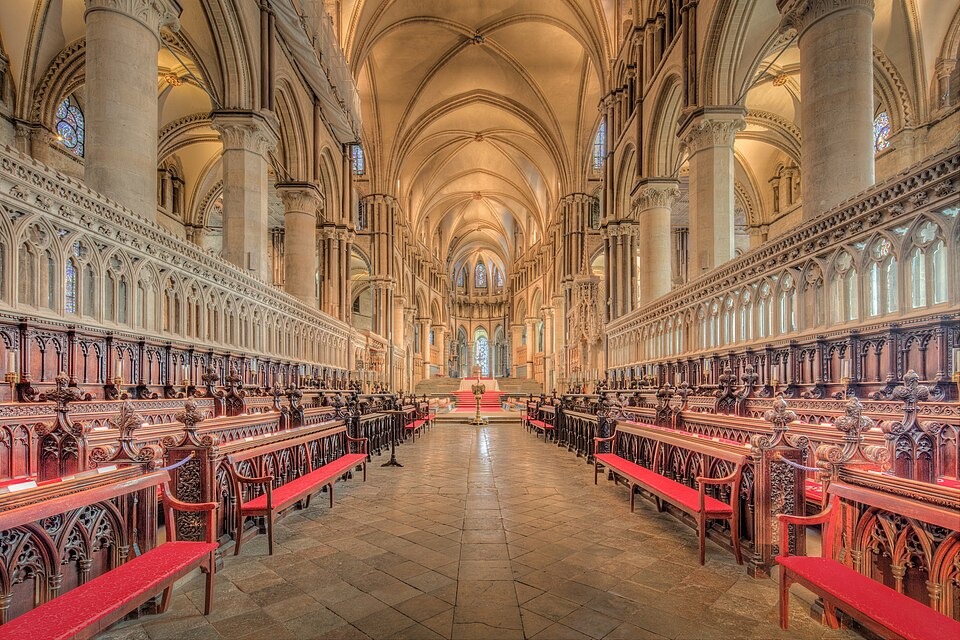
The choir of Canterbury Cathedral, the first construction in England to be
built in Gothic style. Note the pointed arches and rib vaults!
(Beckwith, 2018)
There are various ways that scholars have attempted to categorize and periodize the initial wave of Gothic Architecture in England. Some scholars like to add specific sub-descriptors based on the reigning monarch or dynasty at the time of a building’s construction, e.g. “Elizabethan Gothic” or “Tudor Gothic”. The way that I prefer to do it, based on the sources that I have read, is to split it up into three eras. Their names and time periods are as follows:
Early English Gothic Late 12th – Late 13th Century
Decorated Gothic Late 13th – Late 14th Century
Perpendicular Gothic Late 14th – 17th Century
Around the time of the Great Fire of London in 1666, Gothic fell out of fashion and was supplanted by Christopher Wren and others’ Classical and Baroque churches. This brought an end to the era of Perpendicular Gothic, and all subsequent constructions were self-conscious revivals of an older style. In the next sections, I will display some examples of each of the three main periods, and analyze what features distinguish them from each other. If you learn these differences, you might be able to spot the differences in architectural features for yourself next time you visit a Gothic building. Note: one of the examples I show is from Wales, so don’t go in the comments section complaining that the English Gothic examples I showed aren’t English. England and Wales have been politically and culturally linked for so long, that I’m counting them as one geopolitical entity for the purpose of the article. I know that they are not the same, and Wales has its own language and different culture, please don’t get mad.
Early English Gothic
Early English Gothic began, as previously mentioned, with the reconstruction of the choir of Canterbury Cathedral after a fire devastated the building. Not just builders and styles, but the physical stones used in many early Gothic buildings were imported from England, specifically Normandy, right across the English Channel from England. Maybe you’ll notice that I’ve mentioned fire a few times in this post. Before modern building codes and safer construction techniques, things used to just burn down, all the time. For no apparent reason. It’s kind of like how cars used to be extremely unsafe deathtraps. If you ask anybody older than 65, they probably know 5 or more people that died in car crashes when they were young. Similarly, if you asked a medieval peasant how many buildings they could name that have burned down, they could probably give 10. In Romanesque Architecture, ceilings and roofs were typically wooden and supported with wooden beams. In a place like a church, which has candles constantly burning inside and whose spire can be struck by lightning due to its prominence, these wooden roofs caught on fire all the time (United Nations). But how should roofs be made instead to remedy this common tragedy? This is where and why builders introduced rib vaults. The earliest stone rib vaults in Early English Gothic very simply patterned, and helped support a ceiling as well as your average wooden roof, all while being resistant to fire much better than wooden ones. The pointed arch and buttress also saw its first use in English churches during this period. These three features would be prominent across all three period
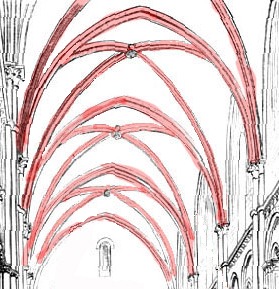
Simple rib vaults are highlighted in red
(Vadnal, 1997)
A typifying feature of Early English Gothic that is not commonly seen in later works is the use of lancet windows. These are very tall, thin, and narrow stained glass windows that end in pointed arches, as is typical of arches but uncommon in stained glass. The prominence of lancet windows in Early English Gothic leads to some referring to the style as “Lancet Gothic” too. Rose windows, which are large, rose-shaped stained glass windows at the entrance of Gothic churches, were very rare in England at the time, but common in continental Europe. These lancet windows reached up into the highest level of the church, which was called the clerestory. For reference, the typical English Gothic church is divided into three above-ground levels. From top to bottom; the clerestory, the triforium, and the arcade
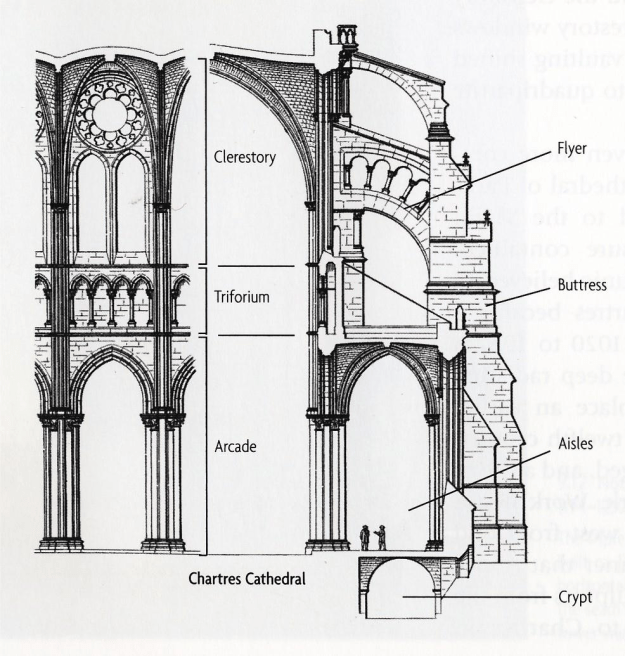
An illustration of the three levels of a Gothic church
(Brown, 2017)
Some prominent examples of Early English Gothic architecture are Wells Cathedral (except the western towers), the great tower of Pembroke Castle, and Lincoln Cathedral. Pictures are provided below with captions explaining the prominent features.
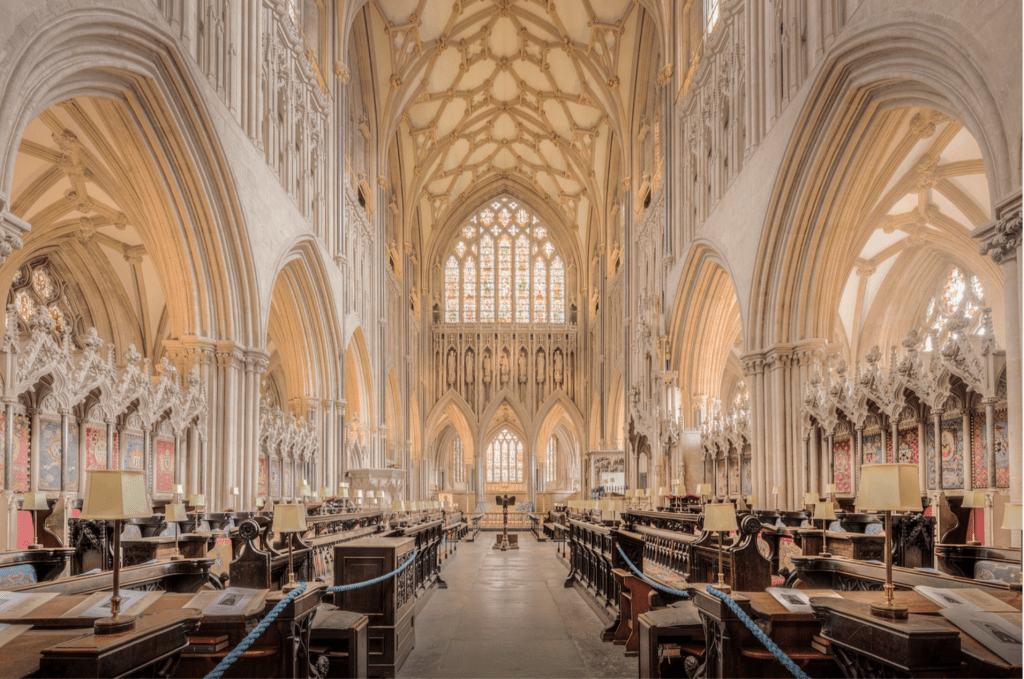
The choir of Wells Cathedral, with pointed arches,
unique rib vaulting, and lancet windows
(National Churches Trust, Wells Cathedral)
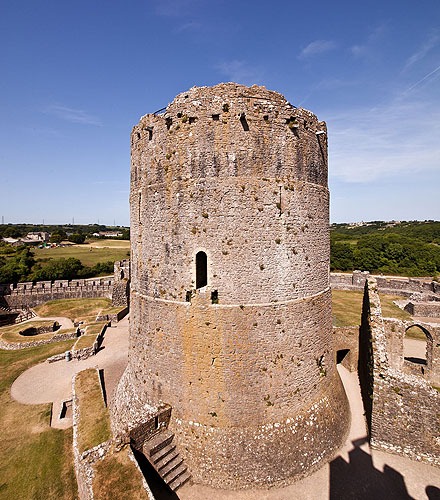
The crumbling Pembroke Castle, with a pointed arch in a small window
(Wales Coast Path Photos)
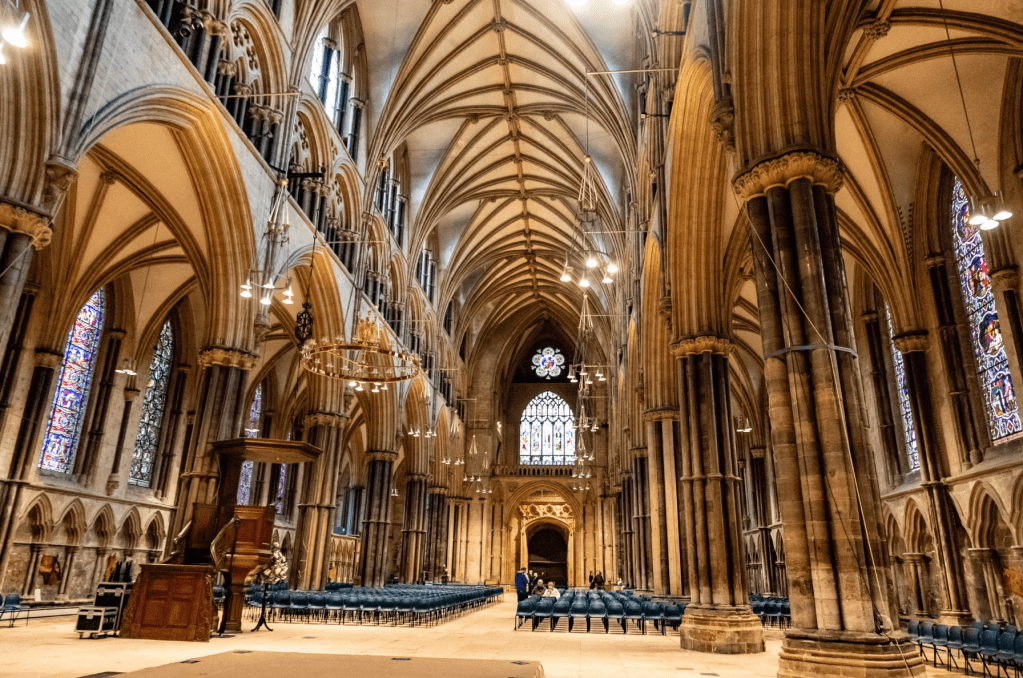
Lincoln Cathedral with pointed arches, simple rib vaults, and lancet windows
(Bird, 2022)
Decorated Gothic
The next period of architecture is known as Decorated Gothic. The name is derived from the large amount of decoration in the interior of buildings during this period. Stone carvings began to pepper the interiors of churches, and exterior protrusions meant to divert water away from the roof started to be carved into grotesque monsters. We know them today as gargoyles, but the name actually predates the foul creature, and is actually derived from an Old French word that means “conduit to help water flow”. Hey, I have to put my Master’s Degree in Linguistics to good work somewhere. The Decorated period coincided with Rayonnant Gothic Architecture in France, which was the third of four periods of French Gothic (L’Histoire, 2018). French Gothic architecture is a whole different can of worms that I can’t get into today, but the Rayonnant style (meaning “radiant” in French) also had similar interior decorations to English Decorated Gothic, and was an influence of English sculptors. During this period, churches that were built in the Early English Gothic style were also updated with new techniques learned from the French Rayonnant style.
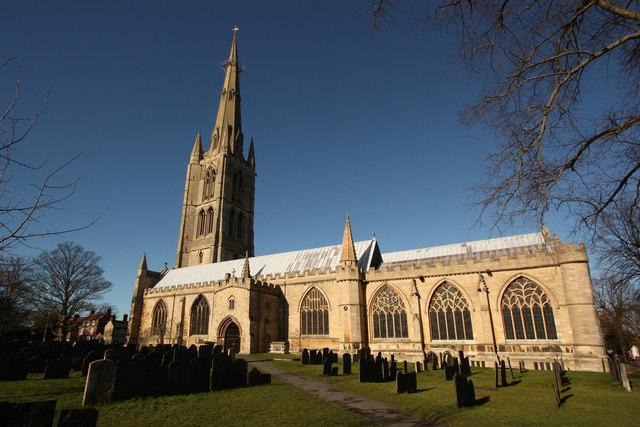
St. Wulfram’s Church in Grantham
(National Churches Trust, St. Wulfram)
What distinguishes Decorated period from earlier and later styles, besides the previously-mentioned interior decoration, are the new techniques of window tracery and lierne vaulting. Tracery is the splitting of stained glass windows into multiple sections using stone moulding (Curl & Wilson, 2015). The east window of Carlisle Cathedral (the space right above the altar) is a great example of Decorated Gothic tracery. As for lierne vaulting, that involves making patterns, notably star-shaped ones, from the ribs that make up the rib vaults of a ceiling. This is purely decorative, and does not add any kind of support advantage (Bond, 1906). This stands in contrast to the earlier, simpler rib vaults. Some great examples this period are Penshurst Place and the Lady Chapel at Ely Cathedral.
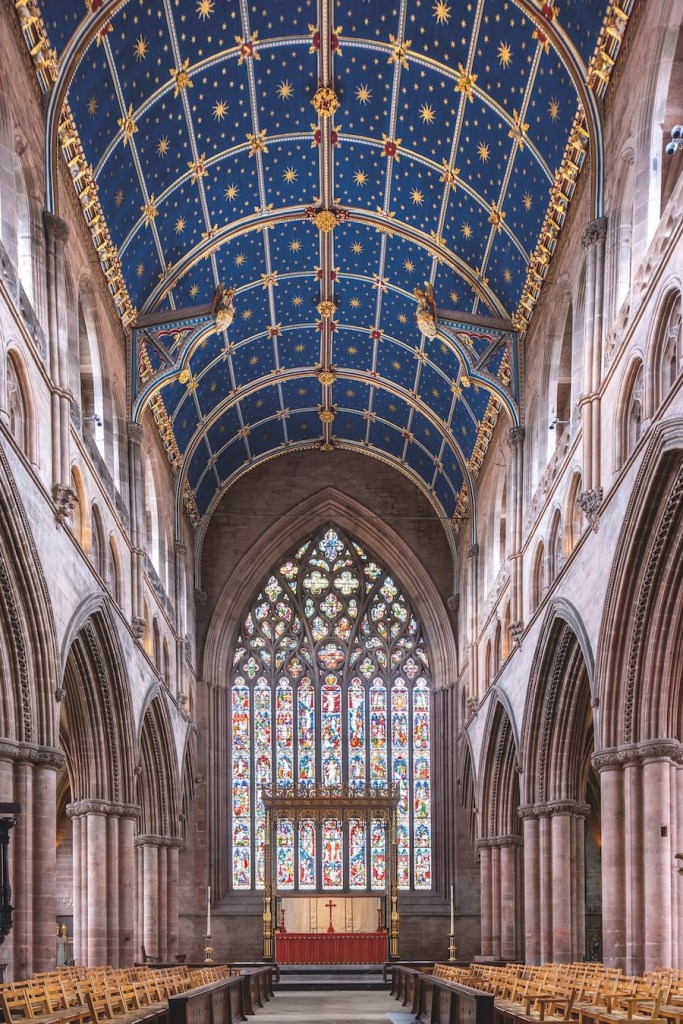
Carlisle Cathedral’s east window tracery
(Association of English Cathedrals)
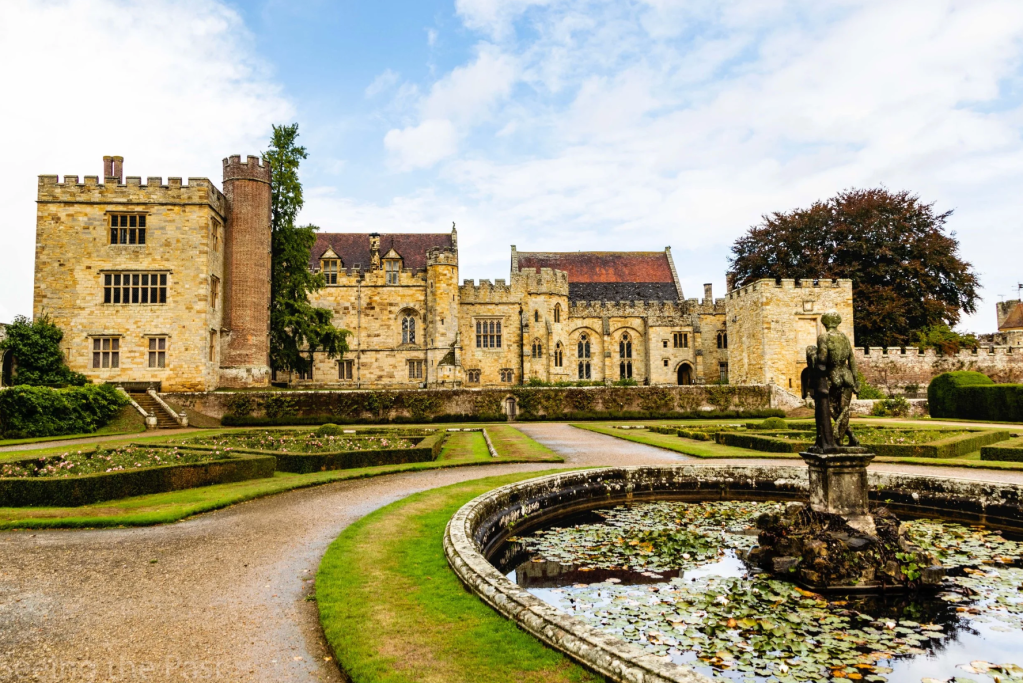
Penshurst Place, a medieval house where Henry VIII later lived
(Bird, 2022)
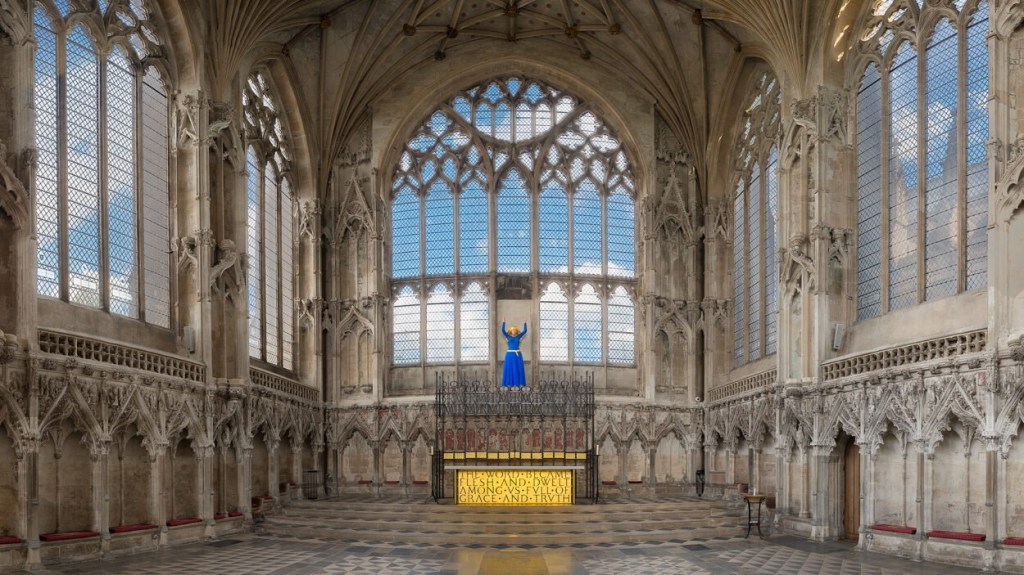
The Lady Chapel at Ely Cathedral, displaying
lierne vaults on the ceiling
(Ely Cathedral)
Perpendicular Gothic
This was the final style of pre-revival Gothic architecture in England and Wales. As a reminder for the geometrically challenged: perpendicular lines are lines which interact at a 90 degree angle. Perpendicular vertical lines were a large point of emphasis in this style. As a result, walls became much higher than in previous Gothic styles. The earliest example of this style was the chapter house of the Old St. Paul’s Cathedral (Harvey, 1978). As a reminder, St. Paul’s Cathedral in London burned down completely during the great fire (good old wooden roofs, huh?) and then rebuilt in Baroque style. Perpendicular Gothic was the longest-lasting of the English Gothic periods, going on for over a century after Gothic was largely abandoned in continental Europe. It lasted so long in fact, that elements of Renaissance, Baroque, and Classical architecture began to be added to Perpendicular Gothic buildings to reflect the shifting preferences of domestic architects.
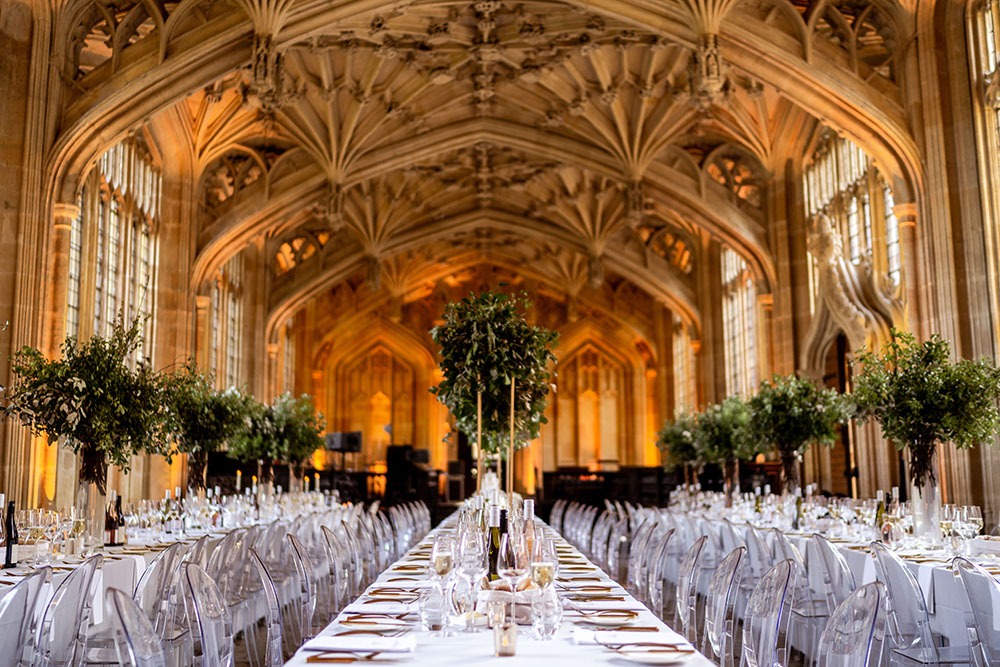
Divinity School at Oxford, with fan vaulting
(University of Oxford)
Some notable characteristics of the Perpendicular period were massive towers on churches, misericords, fan vaulting as opposed to rib vaulting, and huge stained glass windows. Misericords, or mercy seats, were small carvings on the bottom of folding seats in the choir areas. They were so named because they provided a bit of mercy for the choir singers and others in the choir area, as they were easy to lean against for support. Entertainingly, they often had grotesque faces carved onto them. Fan vaulting, as seen in Oxford’s Divinity School above, incredibly complex, interlocking vaulting that evolved from simple rib vaults and moderately complex lierne vaults. Although later revivals borrowed from all periods of Gothic, Perpendicular was the most popular style to use during the Gothic revivals of the 19th and 20th centuries. Some great examples of Perpendicular Gothic architecture are Bath Abbey, Manchester Cathedral, and the Henry VII Chapel at Westminster Abbey.
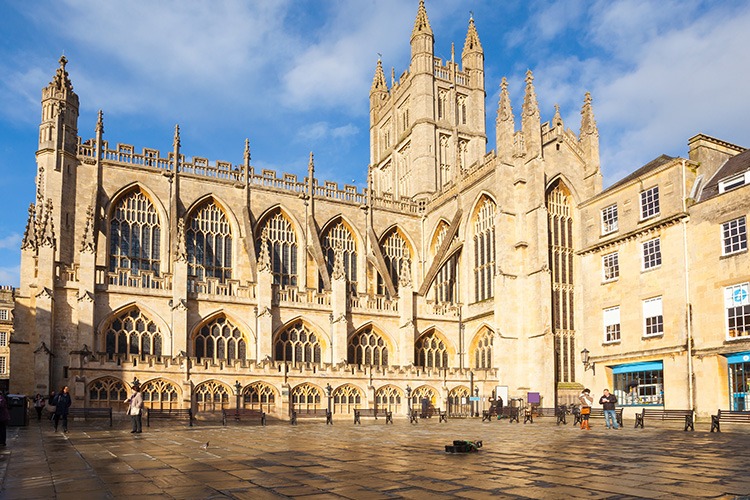
Massive walls and stained glass windows, with exterior
perpendicular lines at Bath Abbey
(Johnson, 2021)
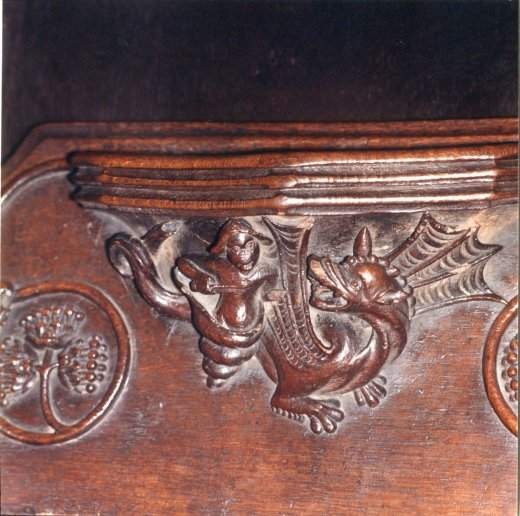
Misericords at Manchester Cathedral
(Kneale, 2025)
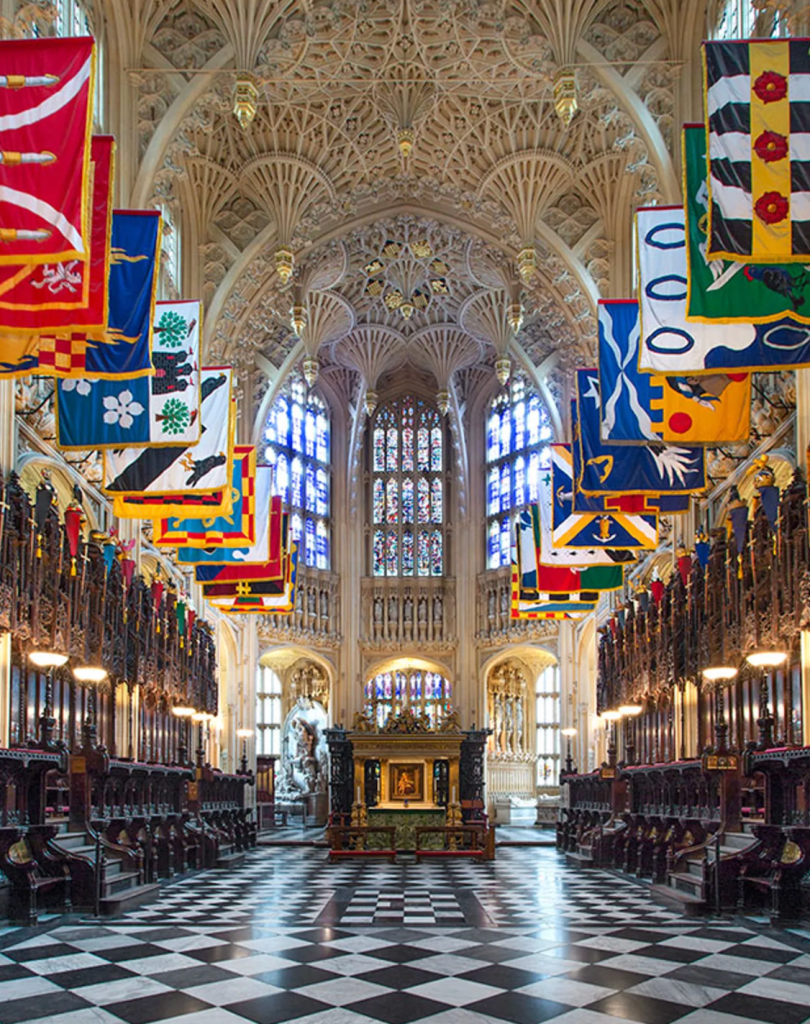
Henry VII Chapel at Westminster Abbey, with prominent fan vaulting
(Westminster Abbey)
With the end of the perpendicular period, we come to the end of our English Gothic architecture journey. Gothic faded, was revived, and then faded again in favor of Art Nouveau, Art Deco, and other modern styles. Maybe someday, it will be revived again, and massive Gothic skyscrapers will dot the skylines of North American and European. And yes, there are Gothic skyscrapers! The Tribune Tower in Chicago is a wonderful example. It’s a great example of how secular architecture can adapt Gothic styles in the 20th century, so why not in the 21st century too? I think a city filled with Neo-Gothic spires would inspire hope, create civic pride, and serve as a beacon of a society that values beauty and edification of the intellect and soul. Thanks for reading again, and I hope you tune in for my future ramblings.
With digital gratitudes and free of platitudes,
Isaiah
Sources Cited
- Association of English Cathedrals. (2026, February 6). The winner – The nation’s favourite stained glass window – East Window – Carlisle Cathedral. https://englishcathedrals.co.uk/latest-news/the-winner-the-nations-favourite-stained-glass-window-east-window-carlisle-cathedral/
- Bird, J. (2022, July 4). Lincoln Cathedral, an awesome gothic building with loads of treasures to discover inside [Photograph]. Seeing the Past. https://www.seeingthepast.com/blog/lincoln-cathedral
- Bird, J. (2022, September 28). Penshurst Place. Seeing the Past. https://www.seeingthepast.com/blog/penshurst-place
- Bogdanović, J. (2010). Opus Francigenum. In R. E. Bjork (Ed.), The Oxford dictionary of the Middle Ages. Oxford University Press.
- Bolton, A. T. (Ed.). (1925). St Paul’s Cathedral. The Wren Society, 2, 15–20. Oxford University Press.
- Bond, F. (1906). Gothic architecture in England. Batsford.
- Booty, J. E., Sykes, S., & Knight, J. (1998). The study of Anglicanism. Fortress Press.
- Brown, M. (2017, May 2). What are the arcade, triforium and clerestory? Matthew Brown Learning Log. https://matthewbrownocalearnerlog.wordpress.com/2017/05/02/what-are-the-arcade-triforium-and-clerestory/
- Cook, G. H. (1949). Portrait of Canterbury Cathedral. Phoenix House.
- Curl, J. S., & Wilson, S. (Eds.). (2015). Tracery. In A dictionary of architecture and landscape architecture (3rd ed.). Oxford University Press. https://doi.org/10.1093/acref/9780199674985.001.0001
- Ely Cathedral. (n.d.). The Lady Chapel. https://www.elycathedral.org/about/history-heritage/the-lady-chapel
- Fraser, M. (Ed.). (2018). Perpendicular Gothic. In Sir Banister Fletcher glossary. Royal Institute of British Architects & University of London. https://doi.org/10.5040/9781350122741.1001816
- Harvey, J. (1978). The perpendicular style. Batsford.
- Herzfeld, E. (2016). The genesis of Islamic art and the problem of Mshatta. In J. M. Bloom (Ed.), Early Islamic art and architecture (F. Hillenbrand & J. M. Bloom, Trans., pp. 35–36). Routledge. (Original work published 1910)
- Johnson, L. (2021, March 25). Bath Abbey. History Hit. https://www.historyhit.com/locations/bath-abbey/
- Kneale, R. (2025, December 4). The history of MGS in 50 objects: 29. Misericords. MGS Life. https://www.mgs-life.co.uk/article/the-history-of-mgs-in-50-objects-29-misericords?ref=64
- L’Histoire. (2018, October 22). L’art gothique à la conquête de l’Europe. https://www.lhistoire.fr/carte/lart-gothique-%C3%A0-la-conqu%C3%AAte-de-leurope
- National Churches Trust. (n.d.). St Wulfram, Grantham. https://www.nationalchurchestrust.org/church/st-wulfram-grantham
- National Churches Trust. (n.d.). Wells Cathedral. https://www.nationalchurchestrust.org/church/wells-cathedral-wells
- The Gothic revival 1720–1870: Literary sources and documents: Gothic and national architecture (Vol. 3). (2002). Helm Information.
- Tinniswood, A. (2001). His invention so fertile: A life of Christopher Wren. Oxford University Press.
- United Nations. (n.d.). Durham World Heritage Site. https://www.un.org/
- University of Oxford. (n.d.). Corporate spaces available. Visit the Bodleian Libraries. https://visit.bodleian.ox.ac.uk/venue-hire/corporate-spaces-available
- Vadnal, J. (1997, August). Rib vault [Illustration]. Glossary of Medieval Art and Architecture. https://sites.pitt.edu/~medart/menuglossary/ribvault.htm
- Vasari, G. (1907). Vasari on technique: Being the introduction to the three arts of design, architecture, sculpture and painting, prefixed to the Lives of the most excellent painters, sculptors and architects (L. S. Maclehose, Trans.; G. B. Brown, Ed.). Dent.
- Wales Coast Path Photos. (2013, July 13). [Photograph]. https://walescoastpathphotos.com/photo_11627623.html
- Watkin, D. (1986). A history of western architecture. Barrie & Jenkins.
- Westminster Abbey. (n.d.). The Lady Chapel. https://www.westminster-abbey.org/history/explore-our-history/lady-chapel


Leave a comment